Datacenter Proxies — Server IPv4 with Auto Rotation | IPrazon
Datacenter proxies

Datacenter Proxies

Datacenter proxies on IPv4 from IPrazon, with addresses hosted in data centers on our own hardware. High speed, low latency, rotation, unlimited traffic, 200+ countries. Free trial up to 2 hours.

Datacenter proxy pricing

Free Trial
$0
up to 2h
  • 12,000 IPs
  • Unlimited Traffic
  • 2000 Threads
  • Global Pool
Start testing
Starter
$20
24h
  • 12,000 IPs
  • Unlimited Traffic
  • 1000 Threads
  • Global Pool
Buy
MOST POPULAR
Business
$100
week
  • 12,000 IPs
  • Unlimited Traffic
  • 1000 Threads
  • Global Pool
Buy
Advanced
$300
month
  • 12,000 IPs
  • Unlimited Traffic
  • 1000 Threads
  • Global Pool
Buy
Enterprise
$600
month
  • 12,000 IPs
  • Unlimited Traffic
  • 3000 Threads
  • Global Pool
Buy
About

What datacenter proxies are

Datacenter proxies are proxies whose IP proxy addresses are hosted in data centers. Thanks to powerful infrastructure they deliver high speed and stability.

The main difference from residential is the IP source. Residential uses addresses of real users; datacenter uses data-center addresses. Datacenter is faster and cheaper, and a perfect fit for technical tasks: parsing, monitoring, automation.

At IPrazon, datacenter proxies run on our own hardware. It is a private IPv4 pool with rotation, unlimited traffic and HTTP, HTTPS and SOCKS5 in every package.

Setup

How to connect datacenter proxies

Datacenter proxies connect to any software that supports proxies:

  1. Get the access data host, port, login, password in your dashboard.
  2. Open the proxy settings in your parser, browser or script.
  3. Choose the protocol: HTTP, HTTPS or SOCKS5, all in the package.
  4. Enter the data and pick login or IP authorization.
  5. Check the connection: proxy requests go through a data-center address.

IP authorization works the same across the datacenter pool: add your address in the dashboard and the login-password pair becomes unnecessary.

Specs

What a datacenter proxy pool is

ParameterValue
Pool typeDatacenter pool on our own hardware
Pool typePrivate datacenter IPv4 base, clients only
Best forScraping, monitoring, automation, QA, anywhere speed matters
Output formatIP:PORT is the main one. IP:PORT:LOGIN:PASS is the second option
Pool size12,000 IPs, rotation runs automatically
ProtocolsSOCKS5 and HTTP/HTTPS
ThreadsUp to 3000 depending on plan
TrafficUnlimited
ConnectionBind your IP in the dashboard for the IP:PORT format
TestFree test up to 2 hours

Datacenter means low latency and high thread counts, built for tasks where collection speed matters.

Detection

Are datacenter proxies detectable

A datacenter IP belongs to a hosting autonomous system, and that is visible in public registries. A site that checks the ASN can tell a datacenter address from a home one. This is a property of the class: the proxy address is transparent about where it lives, and in exchange you get speed and price.

In practice the class matters less than the state of the proxy address. Public lists burn out because thousands of people hammer the same IPs. A private pool that is never resold stays clean far longer. IPrazon proxy addresses are not sold one by one and do not appear in open lists, and rotation spreads the proxy load so no single IP builds up a history of refusals.

For technical work such as collecting open data, price monitoring, checking search results and QA, the class of the proxy address usually does not matter: the target does not care whether the request came from a data center or a flat. On technical work what matters is the state of the proxy address and the request rhythm.

Billing

What you pay for in proxies: package or gigabytes

The market splits by billing model. Per-gigabyte pricing is common with residential providers: the price grows with the volume you pull, and a heavy scrape turns into an invoice nobody predicted. Per-package pricing is the datacenter model: you pay for the term and the number of threads, and volume is not metered at all.

IPrazon runs on the second one. Traffic is unlimited on every plan, from the 24-hour package to the monthly ones, and the bill does not move when a job takes longer than planned. What you scale is the thread count, up to 3000 on the top plan.

This changes how you plan the work. With per-gigabyte billing you budget by volume and keep an eye on the counter. With a package you budget by time and concurrency instead. For collection work of any real size the second is simply easier to forecast, and that is the reason the datacenter class exists at all.

Reading an address

How to see who owns a datacenter address

Every address has a public record in the registries. A whois query shows which organisation the proxy block is allocated to, the country it is registered in and the autonomous system it belongs to. That is open data, and platforms read it the same way you can.

The autonomous system number is the key part. It shows whether a network belongs to a hosting provider or a consumer ISP, and that is exactly what separates a datacenter address from a home one. No proxy setting changes that membership, it is written in the proxy registry.

Block size is worth a look too. If a whole range is allocated to one hosting company and packed with servers, the behaviour of neighbours colours how the entire block is seen. If proxy addresses are scattered across different autonomous systems, that link does not exist.

So when judging a proxy pool what matters is how many distinct autonomous systems it draws from. One large block and the same count of addresses spread across a dozen networks behave differently.

Speed

Why datacenter proxies answer quickly

A datacenter address lives in a facility connected by backbone links. The hardware sits in a rack with redundant power and connectivity, and the route to major networks is usually short. That makes the proxy response even and predictable.

The second factor is the absence of a last mile. On home networks traffic passes through subscriber equipment and an access segment where speed depends on neighbourhood load and line quality. In a data center that segment simply does not exist.

The third factor is stability under load. A datacenter channel is built for a constant stream, so response changes little as thread count grows. For multi-threaded collection that matters more than the raw speed of a single request.

The practical consequence: on tasks that need many identical proxy requests in a row, datacenter proxies give a flatter picture of response time, and planning collection around them is easier.

Use cases

What tasks people use datacenter proxies for

Datacenter proxies are the choice for technical tasks where speed and stability matter:

  • Parsing and data collection from results, sites and marketplaces.
  • SEO and analytics: rank tracking, checking results by region.
  • Price monitoring and tracking changes regularly.
  • Automation and multi-threaded scenarios.

Datacenter proxies are for technical tasks: parsing, monitoring and automation, where they are faster and cheaper.

Infrastructure

Why the IPrazon datacenter proxy pool

The pool runs on our own hardware: stable fast proxy addresses, low latency, uptime without drops. This gives speed most residential solutions cannot reach.

Traffic is unlimited on all packages, and rotation delivers new IPs on schedule or on demand. The pool holds 12,000 IPv4 addresses across 200+ countries, up to 3000 threads.

HTTP, HTTPS and SOCKS5 are in every package, with login/password or IP authorization. The addresses are private and not sold one by one.
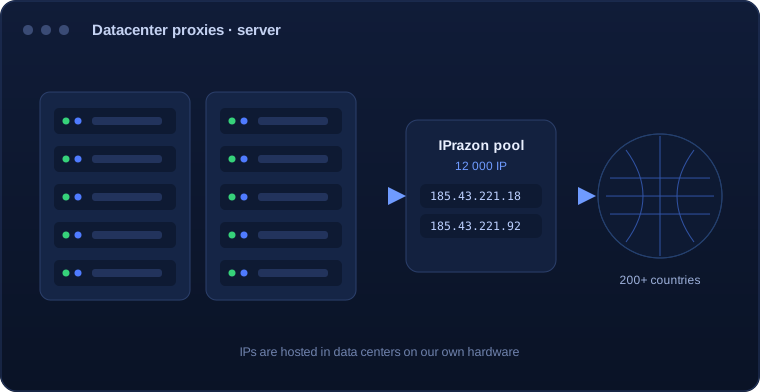
IPrazon datacenter proxies in data centers
IPs are hosted in data centers on IPrazon own hardware
Reviews

Datacenter proxy reviews

★★★★★

Moved from residential to datacenter for speed and price. A perfect fit for parsing and monitoring, low captcha at volume.

E
Ethan R.SEO specialist
★★★★★

Run my tasks on the 2-hour trial, great speed, stable. Unlimited and rotation in every package are handy.

H
Hannah W.webmaster
★★★★★

I run automation in many threads. The datacenter pool handles the load, support replies fast.

M
Mateo G.developer
Free trial

Test datacenter proxies on your task

Before you pay we offer a free trial up to 2 hours. Connect datacenter proxies to your software and check speed and stability.

Get a free trial

FAQ

Datacenter proxy FAQ

How are datacenter proxies different from residential?

Datacenter IPs are hosted in data centers; residential uses addresses of real users. Datacenter is faster and cheaper and fits technical tasks. Datacenter addresses suit technical work where speed and cost matter.

How fast are datacenter proxies?

Fast, addresses on our own hardware with low latency. Exact speed depends on the task and platform, but the datacenter pool is noticeably faster than residential.

What tasks suit datacenter proxies?

Parsing, SEO, price monitoring and automation. The pool is built for technical work: parsing, SEO, price monitoring and automation.

Which protocols are supported?

HTTP, HTTPS and SOCKS5, all are in the package.

Is there rotation and unlimited traffic?

Rotation delivers new IPs on schedule or on demand, and traffic is unlimited on all packages.

How many addresses and countries are in the proxy pool?

12,000 IPv4 addresses across 200+ countries. The addresses are private.

Is there a free trial?

A free trial is available up to 2 hours on your task before you pay.

Source: https://iprazon.com/proxy/datacenter · © IPrazon Network. When copying, an active link to the source is required.