Proxies for ZennoPoster — Automation up to 3000 Threads | IPrazon
Proxies for ZennoPoster

Proxies for ZennoPoster

Datacenter IPv4 and SOCKS5 proxies for ZennoPoster. Stable addresses for automation and multi-threaded templates, rotation, unlimited traffic, 200+ countries. Free trial up to 2 hours.

Pricing for ZennoPoster proxies

Free Trial
$0
up to 2h
  • 12,000 IPs
  • Unlimited Traffic
  • 2000 Threads
  • Global Pool
Start testing
Starter
$20
24h
  • 12,000 IPs
  • Unlimited Traffic
  • 1000 Threads
  • Global Pool
Buy
MOST POPULAR
Business
$100
week
  • 12,000 IPs
  • Unlimited Traffic
  • 1000 Threads
  • Global Pool
Buy
Advanced
$300
month
  • 12,000 IPs
  • Unlimited Traffic
  • 1000 Threads
  • Global Pool
Buy
Enterprise
$600
month
  • 12,000 IPs
  • Unlimited Traffic
  • 3000 Threads
  • Global Pool
Buy
About

What proxies for ZennoPoster are used for

ZennoPoster is a tool for automating browser and network actions: it runs template scenarios in several threads, parsing and recurring routine tasks.

Without proxies all threads go online from the same IP, and platforms apply limits fast. Proxies give each thread its own address, so templates run stably and are not capped by one IP.

Datacenter proxies fit ZennoPoster technical scenarios: parsing, monitoring, automated data collection and API work. Stable addresses and threads handle the load.

Setup

How to connect a proxy to ZennoPoster

ZennoPoster works with proxies through its built-in manager:

  1. Copy the list of addresses from your IPrazon dashboard. The main format is IP:PORT, or IP:PORT:LOGIN:PASS if you need it.
  2. Open the proxy manager in ZennoPoster (ProxyChecker).
  3. Add the list and pick a protocol, either SOCKS5 or HTTP.
  4. Bind proxies to a template or threads.
  5. Run the template: threads are spread across the proxy pool.

You set the number of threads and the action rate in the template itself.

Specs

What proxies you need for ZennoPoster templates

ParameterValue
Manager formatIP:PORT is the main one. IP:PORT:LOGIN:PASS is the second option
Where to addZennoPoster built-in proxy manager, ProxyChecker
BindingTo a template or to threads, your choice
ProtocolSOCKS5 or HTTP, both are in the package
Threads per templateSet in the template itself, pool ceiling is up to 3000
Recurring jobsUnlimited traffic: monitoring and API work with no volume fees
Addresses live12,000 IPs, rotation runs automatically inside the proxy pool
ConnectionBind your IP in the dashboard for the IP:PORT format
Try before payingFree test up to 2 hours

ProxyChecker runs the list before the template starts, handy for checking the proxy pool up front.

Sizing

How many proxies templates and threads need

In ZennoPoster the load is counted by how many templates execute at once. Each thread is a separate sequence of actions, and if a session is held inside it, the proxy address has to stay unchanged until the scenario finishes.

That gives the lower bound for the proxy pool: as many addresses as there are templates running in parallel at peak. If scenarios are short and stateless, one proxy address serves several runs in sequence and the requirement drops.

Duration counts separately. A template that runs for half an hour occupies a proxy address for that whole time, so long scenarios need a noticeably larger pool than short ones even at the same thread count.

Diagnostics

Common proxy connection errors and how to catch them

A proxy connection refusal almost always comes down to four causes, and checking them in this order saves time. First: the wrong proxy type is selected, HTTP where SOCKS5 is needed or the other way round. Second: the port does not match the one issued.

The third cause sits in the format. If the list is issued as IP:PORT with no login, access works by binding, and requests only go through from the address you registered. Changing machine, network or outbound interface returns a refusal on a perfectly working list.

Fourth: a typo in the login or password, most often a trailing space picked up when copying the string. Check separately that ZennoPoster actually routes traffic through the proxy: a connection is confirmed by the source address on an IP test service.

Rotation

How to set up proxy switching in ZennoPoster

Address switching is configured in two places and mixing them up causes trouble. The first is the proxy pool side: the address changes on its own by schedule or per request, and ZennoPoster needs to do nothing. The second is the software side: you feed different strings from the list to different tasks yourself.

The first option suits uniform work where no state is held between requests. The list is connected once and new proxy addresses arrive automatically, with no intervention needed.

The second option is what you need when a template holds state and has to finish the scenario from one proxy address. The address is then pinned explicitly and you decide when to change it: after a cycle finishes, after a number of processed items, or on a timer.

Running both modes on one task is usually harmful. If the proxy pool rotates on its own while the software cycles through the list in parallel, behaviour becomes unpredictable and some requests leave from addresses you did not intend.
Distribution

How to spread proxies across templates in ZennoPoster

The base rule: load has to fall evenly across the proxy pool, otherwise some addresses burn out ahead of the rest. So it is better to assign templates to addresses deliberately than to let the software grab whichever comes first.

When tasks differ in weight, count by intensity. One heavy process can produce more requests than five light ones, and it makes sense to give it dedicated addresses so it does not crowd the others.

Keeping a small reserve of addresses that are not permanently occupied pays off. It comes in useful when part of the proxy pool starts meeting checks: you move the affected tasks onto fresh proxy addresses without stopping everything.

And finally, record which task ran from which address. Without that, when refusals appear there is no way to tell whether the cause is a specific address, the task settings or the platform itself.

Use cases

What tasks people use ZennoPoster proxies for

Datacenter proxies in ZennoPoster are used for technical automations:

  • Parsing and data collection by templates in several threads.
  • Monitoring sites, prices and changes on a regular basis.
  • Automating routine tasks and API work.
  • Checking and processing lists in multiple threads.

Datacenter proxies are built for technical scenarios: data collection, page checks and multi-threaded automation.

Infrastructure

Why IPrazon datacenter proxies fit ZennoPoster

The datacenter pool means stable fast addresses, rotation on schedule or on demand and up to 3000 threads per plan. Long automations need a stable connection.

Traffic is unlimited on all packages, convenient for recurring and long templates. The pool holds 12,000 addresses across 200+ countries.

SOCKS5 and HTTP are in the package, with login/password or IP authorization. ZennoPoster works with both through the proxy manager.

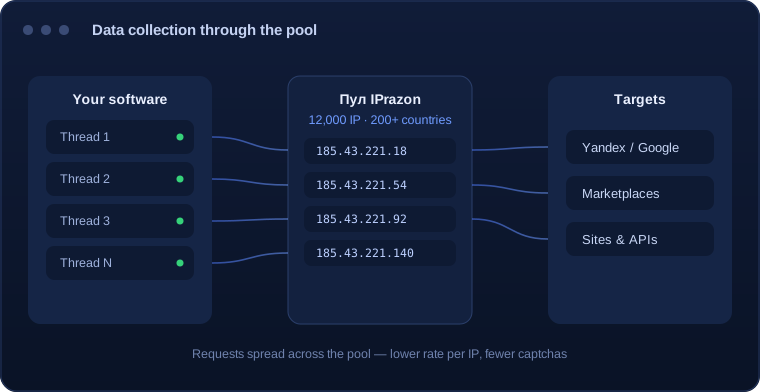
ZennoPoster threads spread across the IPrazon pool
ZennoPoster threads spread across the proxy pool of 12,000 addresses
Reviews

Reviews of ZennoPoster proxies

★★★★★

I run parsing and monitoring templates in many threads. The pool is stable, threads do not drop, I set rotation myself.

A
Adrian F.automation engineer
★★★★★

Ran my templates on the 2-hour trial, all smooth. Unlimited traffic for long tasks is convenient.

M
Maya S.webmaster
★★★★★

Recurring automations run around the clock. Support is on Telegram and replies to the point.

N
Nathan P.developer
Free trial

Test the proxies on your templates

A free trial of up to 2 hours comes before any payment. Wire the proxy pool into a real template and watch how the threads hold under your own load.

Get a free trial

FAQ

ZennoPoster proxy FAQ

How do I connect proxies to ZennoPoster?

Add addresses as IP:port:login:password to the ZennoPoster proxy manager and pick SOCKS5 or HTTP. Both are in the package.

How many threads can I run?

Up to 3000 threads on the top plan, spread across a proxy pool of 12,000 addresses.

Do datacenter proxies work for ZennoPoster?

For technical scenarios, parsing and automation, they do. The pool is built for that kind of template.

Is there a traffic limit?

No, traffic is unlimited on all packages.

Can I use rotation?

You can: new IPs are delivered on schedule or on demand, or a stable address is kept per thread.

Which protocols are supported?

SOCKS5 and HTTP, both are in the package.

Can I test it?

A free trial is available up to 2 hours on your templates before you pay.

Source: https://iprazon.com/tools/zennoposter · © IPrazon Network. When copying, an active link to the source is required.